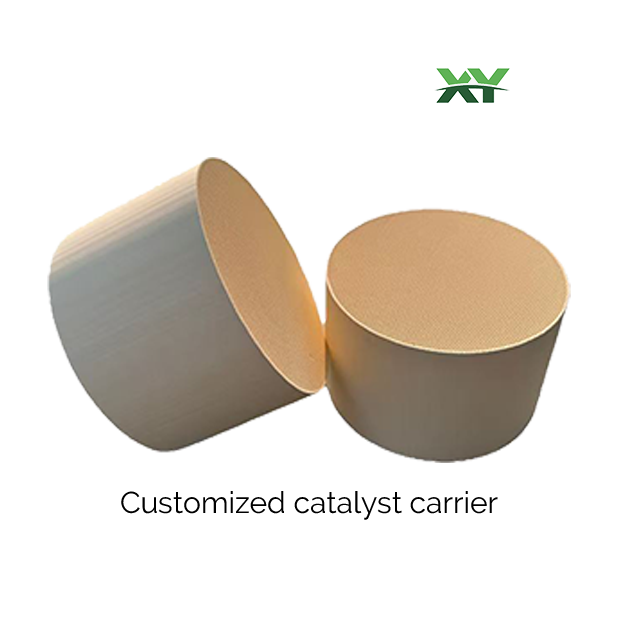
How to change the catalytic converter(shared by https://www.gaslyst.com) Shandong Xiaoyuan Environmental protection technology Co.,ltd I. Preparations Before Replacement 1. Safety Tools and Equipment: • Jack and support frame • Socket wrench, open-end wrench, universal joint • Non-slip gloves, safety goggles • WD-40 or other lubricant (to prevent bolts from rusting) • New catalytic converter (model matching original) 2. Vehicle Preparation: • Park on a level surface • Engage the handbrake • Ensure the engine is completely cooled (catalytic converter temperature is very high, easily causing burns) • Disconnect the negative terminal of the battery to prevent accidental triggering of the oxygen sensor alarm 3. Spare Parts: • New catalytic converter • New gasket • If damaged, the oxygen sensor (O2 sensor) may need to be replaced. ⸻II. Replacement Steps 1. Locate the Catalytic Converter • The catalytic converter is usually located after the exhaust manifold and before the muffler. • In diesel vehicles, it may be before the DOC and DPF. • Note the oxygen sensors before and after the catalytic converter; they need to be removed during replacement. 2. Remove the Oxygen Sensor • Use an O2 sensor socket or open-end wrench to unscrew it counterclockwise. • Be careful not to damage the sensor wiring harness. 3. Loosen the catalytic converter mounting bolts. • The catalytic converter is usually fixed to the exhaust pipe with flange bolts. • Spray lubricant on rusted bolts and wait 5–10 minutes. • Use a socket wrench to loosen slowly, do not use excessive force to avoid breakage. 4. Remove the old catalytic converter. • Remove it gently, being careful not to damage the exhaust pipe and suspension bracket. • Check if the flange sealing surface is flat; repair any corrosion or deformation. 5. Install the new catalytic converter. 1. Install the new gasket (ensure alignment). 2. Install the new catalytic converter, first hand-tightening the mounting bolts to ensure correct positioning. 3. Then use a wrench to tighten evenly, avoiding overtightening to prevent flange deformation. 6. Reinstall the oxygen sensor. • Use an O2 sensor socket wrench to screw it back on with moderate torque. • Be careful not to twist the sensor wiring harness or allow it to come into contact with high-temperature components. 7. Check. • Confirm that the catalytic converter is securely fixed and the oxygen sensor connection is normal. • There are no obvious gaps in the exhaust pipe. • Reconnect the battery negative terminal. ⸻III. Precautions 1. Avoid high-temperature operation: The catalytic converter's temperature can reach 400–600°C immediately after engine shutdown. 2. Ensure model compatibility: Different vehicle models have different catalytic converter apertures, lengths, and oxygen sensor interfaces. 3. Environmental requirements: Removed catalytic converters contain precious metals and should be recycled according to local regulations. 4. Engine fault codes (MIL): • After replacement, P0420 or similar codes may appear, requiring clearing the fault codes or waiting for self-learning. 5. Do not forcefully strike: The ceramic inside the old catalytic converter is fragile; avoid allowing fragments to enter the exhaust pipe. 6. Torque requirements: • Flange bolts are generally recommended at 20–40 Nm (depending on the vehicle model). • Oxygen sensor torque is generally 30–40 Nm. ⸻ Tips: • If the catalytic converter is only partially blocked, you can try cleaning or high-temperature regeneration first, but severe blockage still requires replacement. • For diesel vehicles, note that the catalytic converter after the DPF (DOC) and the oxidation catalytic converter are usually replaced or inspected together to ensure regeneration efficiency.
| 
 ASK & HELP
461 Read
|
0 Reply
|
2025-12-11
ASK & HELP
461 Read
|
0 Reply
|
2025-12-11